For small businesses, every hour and every customer touchpoint counts. Marketing teams in SMEs are often lean, yet expected to deliver personalised campaigns across email, social, and multiple channels. Without automation, this leads to wasted time, missed opportunities, and inconsistent communication.
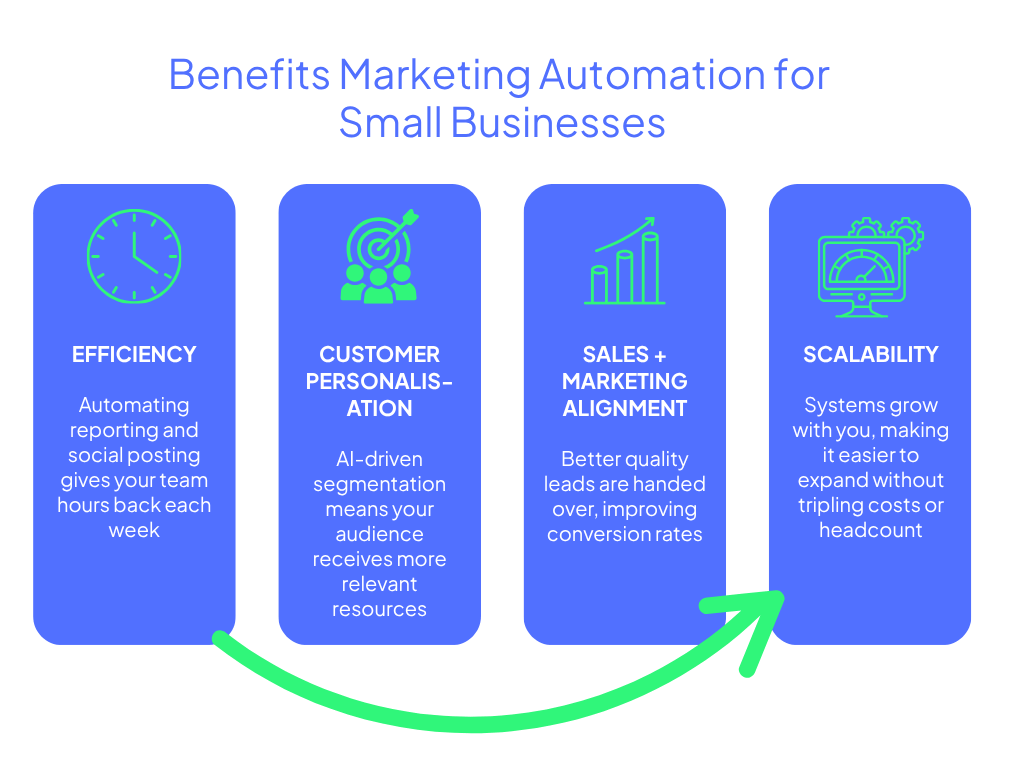
Benefits of Marketing Automation for Small Businesses
An AI-powered marketing automation system changes this dynamic. It helps you:
- Save time by automating repetitive tasks like follow-ups and social posting
- Improve lead management with AI-driven scoring and nurturing
- Deliver personalisation at scale without burning out your team
- Align marketing and sales for better handoffs and conversions
Benefits of AI Marketing Automation for Small Businesses
Marketing automation isn’t just about convenience; it delivers measurable outcomes:
- Efficiency: Automating emails, reporting, and social posting gives your team hours back each week.
- Customer Personalisation: AI-driven segmentation means your audience receives content that resonates.
- Sales + Marketing Alignment: Better quality leads are handed over, improving conversion rates.
- Scalability: Systems grow with you, making it easier to expand without tripling costs or headcount.
Key Features of AI Marketing Automation Tools
When evaluating small business marketing automation tools, focus on core features that make a real difference:
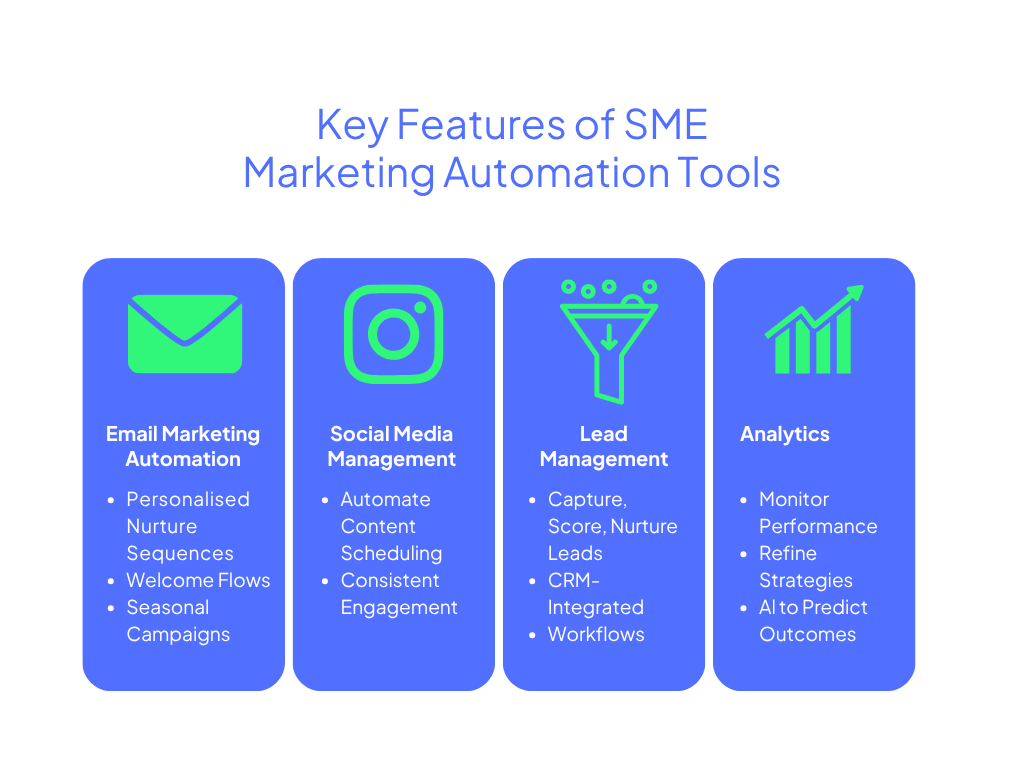
- Email Marketing Automation: Trigger personalised nurture sequences, welcome flows, and seasonal campaigns.
- Social Media Management: Automate content scheduling and ensure consistent engagement across platforms.
- Lead Management: Capture, score, and nurture leads with CRM-integrated workflows.
- Analytics: Monitor performance, refine strategies, and use AI to predict outcomes.
Key Features of SME Marketing Automation Tools
When it comes to small business marketing automation, the right tool depends on your goals, budget, and team capacity. Below is a breakdown of some of the best AI CRM and marketing automation platforms designed for SMEs.
Best Marketing AI Systems and Tools for SMEs
| TOOL | BEST FOR | KEY FEATURES | AI FEATURES | FREE PLAN? | STARTING PRICE | LEARN MORE |
HubSpot Starter | All-in-one CRM + marketing automation | Email campaigns, landing pages, live chat, CRM pipelines | AI send-time optimisation, content recommendations | ✅ | £18/month | 🔗 Visit HubSpot |
| Mailerlite | Simple, affordable email automation | Drag-and-drop builder, landing pages, sign-up forms | AI subject line generator, smart campaign timing | ✅ | £9/month | 🔗 Visit Mailerlite |
| ActiveCampaign | Advanced segmentation + sales automation | Predictive sending, CRM integration, SMS automation | AI lead scoring, behaviour-based segmentation | ❌ | £29/month | 🔗 Visit ActiveCampaign |
| Zoho CRM + Marketing Automation | Integrated ecosystem (CRM + marketing) | Multi-channel workflows, analytics, sales forecasting | “Zia” AI assistant for predictions & insights | ✅ | £14/user/month | 🔗 Visit Zoho |
| Zapier | Connecting tools & workflow automation | 5,000+ app integrations, triggers, data sync | AI-enhanced automation rules, smart enrichment | ✅ | £0 (free tier) | 🔗 Visit Zapier |
| Marketo Engage (Adobe) | Advanced B2B lead nurturing | Multi-channel marketing, analytics, personalisation | Predictive scoring, adaptive content, AI insights | ❌ | Custom (from £65/month) | 🔗 Visit Marketo |
| Freshsales (Freshworks) | CRM + marketing bundle for SMEs | Email, chat, phone, automation workflows | AI deal insights, predictive analytics | ✅ | £12/month | 🔗 Visit Freshsales |
HubSpot is one of the most popular all-in-one marketing platforms, and the Starter tier is designed with SMEs in mind.
Key Features:
- Email automation, landing pages, forms, and live chat
- CRM integration with contact scoring and deal pipelines
- AI-driven recommendations for email send times and content optimisation
- Reporting dashboards for campaigns and ROI tracking
Why SMEs Love It:
It’s easy to set up, scales as you grow, and combines marketing + sales in one system.
Best For: SMEs looking for an affordable but comprehensive solution that can grow into a full enterprise CRM.
Mailerlite is perfect for small teams that need simplicity + effectiveness without heavy costs.
Key Features:
- Drag-and-drop email automation builder
- Personalised email nurture campaigns
- Landing page creation and sign-up forms
- AI subject line generator for higher open rates
Why SMEs Love It:
Clean, intuitive interface with low monthly costs. Great entry point for founders or small marketing teams.
Best For: SMEs focused mainly on email nurture automation and simple marketing workflows.
A favourite among SMEs that want powerful segmentation + sales integration.
Key Features:
- Advanced email automation and personalisation
- CRM integration with AI lead scoring
- Predictive sending to increase open rates
- SMS automation alongside email campaigns
Why SMEs Love It:
It’s flexible, supports complex customer journeys, and integrates well with e-commerce.
Best For: SMEs in growth stage that need a blend of marketing + sales automation with AI-driven insights.
Zoho is a robust ecosystem with tools that SMEs can mix and match.
Key Features:
- AI assistant “Zia” for sales predictions and customer insights
- Lead and deal management integrated with campaigns
- Automated workflows across marketing, sales, and support
- Affordable per-user pricing
Why SMEs Love It:
Scalable and modular — you only pay for the apps you need.
Best For: SMEs looking for an integrated ecosystem (CRM, marketing, analytics) at a budget-friendly price.
Not a CRM itself, but the glue that connects multiple tools.
Key Features:
- Automates workflows between 5,000+ apps
- Triggers actions based on customer behaviour (e.g., form submission → email sequence → CRM update)
- AI-enhanced integrations for data enrichment and analytics
Why SMEs Love It:
Lets small teams stitch together best-in-class tools without coding.
Best For: SMEs with multiple point solutions (like Mailerlite + Slack + Trello) that need automation to tie everything together.
Marketo is more enterprise-oriented but has become increasingly SME-friendly for those scaling quickly.
Key Features:
- Advanced lead nurturing and scoring
- Predictive analytics and AI-driven personalisation
- Multi-channel marketing (email, SMS, ads, web personalisation)
- Strong reporting and attribution features
Why SMEs Love It:
A powerhouse system for SMEs transitioning into mid-market.
Best For: SMEs with complex B2B journeys or high-growth start-ups looking for enterprise-grade automation early.
An underrated gem for SMEs needing an AI-powered CRM with built-in marketing.
Key Features:
- AI deal insights to predict which leads will close
- Email, chat, and phone integration in one system
- Workflow automation for follow-ups and reminders
- Reporting dashboards with predictive analytics
Why SMEs Love It:
Affordable CRM + marketing automation bundled, without the learning curve of Salesforce.
Best For: SMEs seeking a simple but AI-enhanced CRM with marketing capabilities.
Setting Up Marketing Automation in Your SME
Implementing marketing automation can feel daunting at first, but breaking it into clear steps makes the process manageable. Think of it as laying the foundation for a smarter, more efficient growth engine.
Email Nurture Automation
An effective nurture sequence can turn quiet subscribers into loyal customers — but it only works if it’s planned around your customer journey. Most SMEs send newsletters; the smart ones design flows that guide interest into action. The challenge lies in knowing what to automate, how to segment, and when to step in with a human touch.
Marketing Automation for B2B SMEs
B2B growth depends on timing and precision. Account-based workflows, demo follow-ups, and lead scoring can help shorten long sales cycles — but only if your data, content, and tech stack are aligned. Without that foundation, automation adds noise instead of clarity.
DIY gives you control — but it’s slow to scale and easy to get stuck in setup. Agencies accelerate the process but need clear strategy and systems to build on. The sweet spot for most SMEs is understanding enough to stay in control, while getting expert support to execute efficiently.
AI Writing and Content Tools for SMEs
AI can help generate ideas, write drafts, and optimise content — but that’s just the surface. To see real impact, your content needs to feed directly into automated workflows that nurture leads, build authority, and drive action. That connection between AI and automation is where most SMEs fall short.
Sales + Marketing Automation Crossover
When sales and marketing operate separately, leads fall through the cracks. Automation should close that gap — sharing data, triggering timely follow-ups, and surfacing insights both teams can act on. Building that crossover is less about tools, more about structure.
How to Choose the Right Tool
The right platform depends on more than features. You need a system that fits your goals, integrates smoothly with your existing stack, and scales with your business. Most SMEs discover too late that setup — not selection — determines success.
Where to Start
Automation is powerful, but it’s not plug-and-play. Getting it right means aligning your data, workflows, and goals before switching anything on. For most small businesses, that alignment is the missing piece.
Not sure where to begin?
If you’re unsure where to begin, book an AI Strategy Call — a short session designed to help SMEs map their marketing systems, identify the gaps, and plan a smarter path to automation.
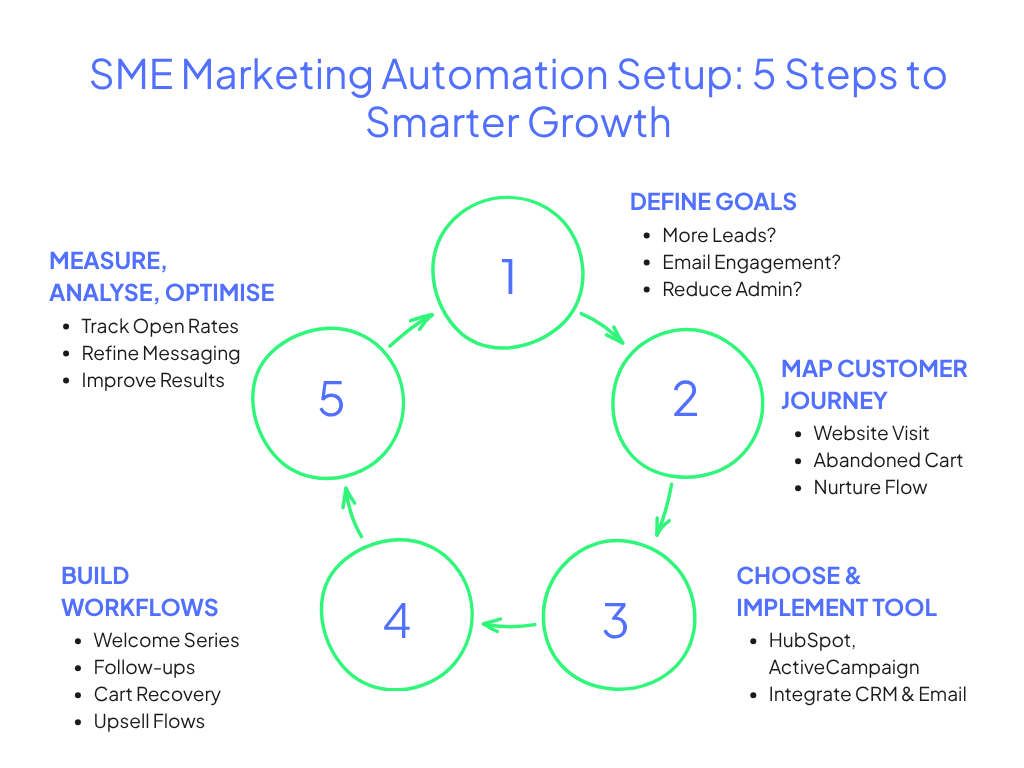
Implementing marketing automation can feel daunting at first, but breaking it into clear steps makes the process manageable. Think of it as laying the foundation for a smarter, more efficient growth engine.
1. Define Your Goals
Start by clarifying exactly what you want automation to achieve. Do you want to generate more leads, increase email engagement, reduce manual admin, or shorten your sales cycle? Setting specific, measurable goals ensures you can align the right tools and workflows to real outcomes, not just “more automation.”
2. Map Your Customer Journey
Every business has touchpoints where prospects engage — from downloading a guide to booking a demo. Map out this journey and highlight where automation can add the most value. For example: a welcome email after a sign-up, reminders for abandoned carts, or a nurture flow for prospects not yet ready to buy.
3. Choose and Implement Your Tool
Pick the platform that matches your budget, team skills, and growth needs. For example:
- HubSpot for all-in-one CRM and marketing
- ActiveCampaign for advanced personalisation and segmentation
- Mailerlite for cost-effective, simple email workflows
Implementation doesn’t need to be complex — start with essential integrations like your CRM, email list, and website forms.
4. Build Workflows
This is where the real power of automation kicks in. Create automated sequences for:
- Welcome campaigns for new subscribers
- Follow-up reminders for leads after initial contact
- Abandoned cart recovery to save lost revenue
- Upsell or cross-sell flows for existing customers
Keep workflows simple to begin with — you can always add complexity later once you see what works.
5. Measure, Analyse, Optimise
Automation is never “set and forget.” Use your dashboard to track open rates, click-throughs, conversions, and revenue impact. Ask: which emails drive engagement, which workflows are underperforming, and where customers drop off? With this data, you can refine messaging, timing, and targeting to continuously improve results.

The Future of Marketing Automation
Marketing automation is moving beyond simple workflows and scheduled emails. With AI at its core, the next stage is about making systems smarter, more predictive, and more human-like in how they interact with customers.
Predictive Lead Scoring
Instead of manually deciding which leads are “hot,” AI analyses behaviour — clicks, downloads, time spent on site — and ranks prospects by likelihood to convert. For SMEs, this means your sales team can focus their limited time on the leads that truly matter.
Dynamic Content Personalisation at Scale
No more generic newsletters or one-size-fits-all campaigns. AI allows content to adapt in real time based on each user’s preferences and past behaviour. An SME can send 1,000 emails, but each recipient sees a tailored subject line, product offer, or call-to-action, increasing relevance and conversions.
AI Chatbots and Voice Tools
Customer support is shifting to 24/7 availability. AI chatbots can handle FAQs, book appointments, and qualify leads before a human steps in. Voice AI, integrated into CRMs, allows teams to capture notes, dictate follow-ups, or even engage customers through smart assistants. This reduces workload while keeping customer service fast and accessible.
Real-Time Analytics Dashboards
Gone are the days of waiting until the end of the month for campaign reports. AI-driven dashboards provide live insights — showing what’s working and what’s failing in real time. For SMEs, this means quicker pivots, more agile campaigns, and less money wasted on underperforming tactics.
Ready to Scale Smarter?
Marketing automation is no longer a luxury for SMEs — it’s a necessity. With the right systems, you can compete with larger players, save time, and focus on building customer relationships.
Take our quick AI Readiness Quiz to discover if your business is ready for marketing automation.