For small business founders, automation isn’t just a technology choice — it’s a strategy decision. The “best” tool depends not on what’s trending, but on what kind of business you run, the size of your team, and how you sell.
A consulting agency will need tools that handle client onboarding and proposal follow-ups. A local retailer needs automation for inventory and customer loyalty. A SaaS startup needs tight alignment between marketing campaigns and user analytics.
This post goes beyond feature lists. It helps you choose the right AI marketing automation tool by showing how real business types use them — and what actually works at their stage of growth.
Service-Based Businesses
Automate Relationships, Not Just Reminders
If you run a consultancy, agency, or professional service, your biggest bottleneck isn’t finding leads — it’s staying on top of them.
Building consistent, personalised client communication without burning hours on admin.
CRM-driven automation with AI-assisted follow-ups.
Use case:
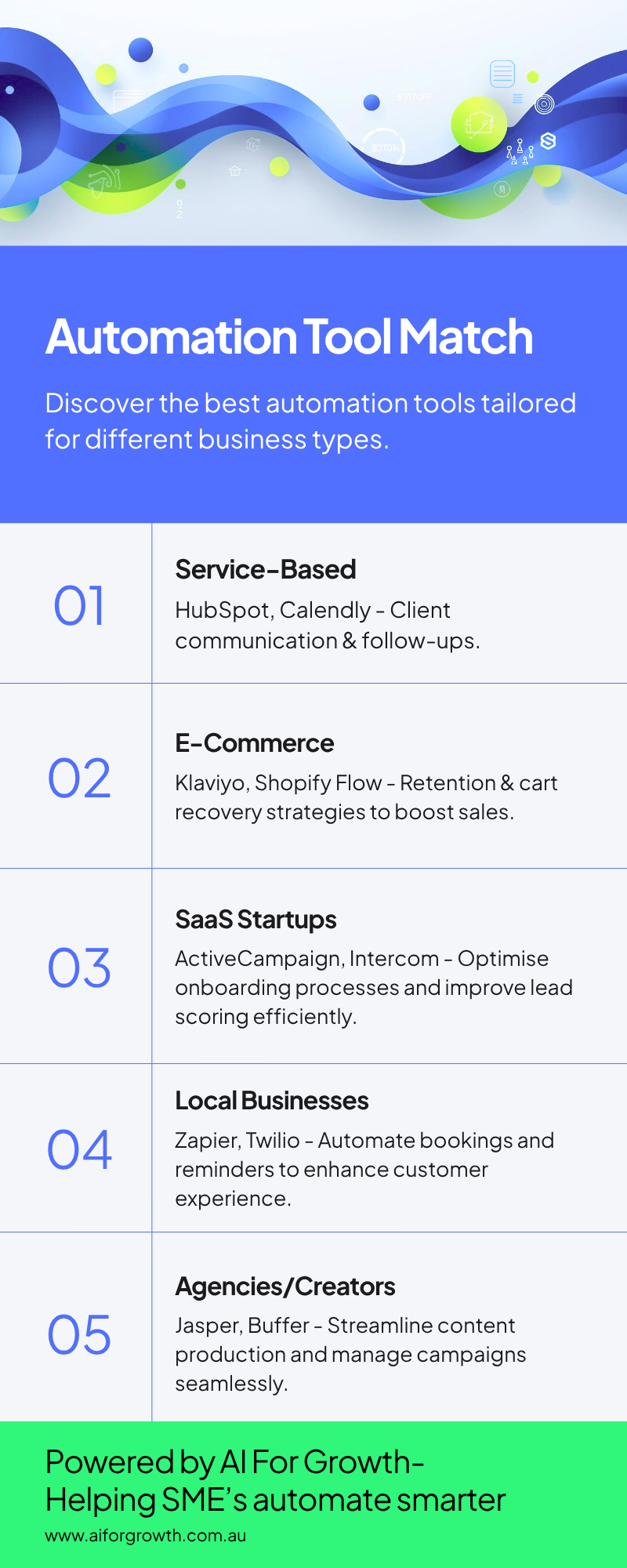
- A design studio uses HubSpot to automatically tag leads from its website, send personalised proposal reminders, and update deal stages when clients open quotes.
- Automated sequences nurture leads who didn’t respond, while analytics show which offers convert best.
Why it works:
Service businesses thrive on relationships. Automation ensures those relationships don’t slip through the cracks — it’s like adding an account manager who never sleeps.
Recommended Stack:
HubSpot (CRM + workflows), Calendly (booking automation), and Zapier (to sync tools).
E-Commerce & Retail
From Clicks to Repeat Customers
E-commerce founders often over-invest in ads but under-invest in post-purchase automation. The right system turns one-time buyers into loyal customers.
Your Core Need:
Automate product recommendations, cart recovery, and customer retention.
Best Tool Type:
AI-driven email and SMS automation connected to your store platform.
Use case:
- A boutique using Klaviyo and Shopify Flow automates restock alerts and sends dynamic recommendations based on past purchases.
- Abandoned carts trigger emails with product reminders and incentives, reducing lost revenue by 20%.
Why it works:
E-commerce automation closes the “lost lead” gap — every customer action feeds your next message.
Recommended Stack:
Klaviyo or Omnisend (email & SMS), Shopify Flow (workflow), Google Analytics (tracking).
SaaS Startups
Data-Driven Automation for Conversions
SaaS companies live or die by how well they nurture free-trial users into paying customers. Manual follow-up doesn’t scale — intelligent automation does.
Your Core Need:
Lead scoring, lifecycle emails, and customer retention workflows that adapt to user behaviour.
Best Tool Type:
AI-powered workflow automation tools integrated with analytics and CRM systems.
Use case:
- A project-management startup uses ActiveCampaign to trigger different onboarding emails depending on user actions — skipping setup prompts for active users, nudging inactive ones with tutorials.
- Sales sees who’s most engaged and follows up personally at the right time.
Why it works:
Automation transforms onboarding from reactive to predictive — responding to what users do, not what you think they’ll do.
Recommended Stack:
ActiveCampaign (marketing + CRM), Intercom (in-app messaging), Segment (data pipeline).
Brick-and-Mortar Businesses
Bridging Offline and Online
Local businesses often underestimate how much automation can do for them — even without a big digital presence.
Your Core Need:
Simplify customer bookings, manage reminders, and gather reviews automatically.
Best Tool Type:
Workflow automation tools that connect scheduling, payments, and messaging.
Use case:
- A fitness studio uses Zapier to link Stripe payments with Google Sheets and SMS reminders. When someone books a class, an automated confirmation and post-session feedback message go out.
- Reviews are automatically requested 24 hours later.
Why it works:
Automation turns one manual touchpoint into three customer experiences — booking, communication, and feedback — all without human input.
Recommended Stack:
Zapier (workflow), Google Workspace (sheets/forms), Twilio (SMS).
Agencies & Creators
Content and Campaign Automation
Agencies and content-driven businesses need volume — frequent campaigns, quick delivery, and consistent quality.
Your Core Need:
Generate, schedule, and optimise marketing content across multiple clients or channels.
Best Tool Type:
AI-writing and content-automation platforms integrated with scheduling tools.
Use case:
- A small digital agency uses Jasper for AI copywriting and Buffer for social scheduling.
- Reports are generated weekly using Notion + Zapier, saving eight hours of manual reporting.
Why it works:
Content automation frees up creative energy for strategy and innovation instead of repetitive admin.
Recommended Stack:
Jasper (AI writing), Buffer (social automation), Notion + Zapier (reporting).
How to Evaluate the “Fit” of Any Automation Tool
Regardless of your business type, every automation investment should pass the F.I.T. test:
| Factor | What to Ask | Why It Matters |
| Functionality | Does it handle your specific workflow needs? | Avoid paying for unnecessary features. |
| Integration | Can it connect easily with your CRM, email, and data systems? | Data silos kill automation ROI. |
| Time to Value | How long before you see measurable results? | Quick wins build buy-in and momentum. |
If a tool scores high across all three, it’s not just automation — it’s acceleration.
What next?
The best marketing automation tools for small businesses aren’t chosen from a list — they’re chosen through clarity.
Understand your business model, define your workflow pain points, and select the automation tools that fill those gaps, not just the ones that look impressive in demos.
Want to see how automation fits your business type?
Take the AI Readiness Quiz to find your automation maturity score.
Frequently Asked Questions
HubSpot and ActiveCampaign work best for relationship-based businesses that depend on client communication and follow-ups.
Use email and SMS automation through platforms like Klaviyo to re-engage shoppers and recover abandoned carts.
Start small — automate one repetitive process like scheduling or reporting. You’ll gain time and confidence to expand later.